

If you’ve ever watched a polished corporate video, commercial, interview, or social media campaign and thought, "That probably took a lot of work," you’re right. What you see on screen is only the final part of a much bigger process.
Before the cameras come out, there are ideas to develop, scripts to write, locations to consider, schedules to build and shots to plan. Once filming is done, there’s still editing, sound, colour, graphics, revisions and final delivery. So, what actually happens between having an idea for a video and watching the finished product?
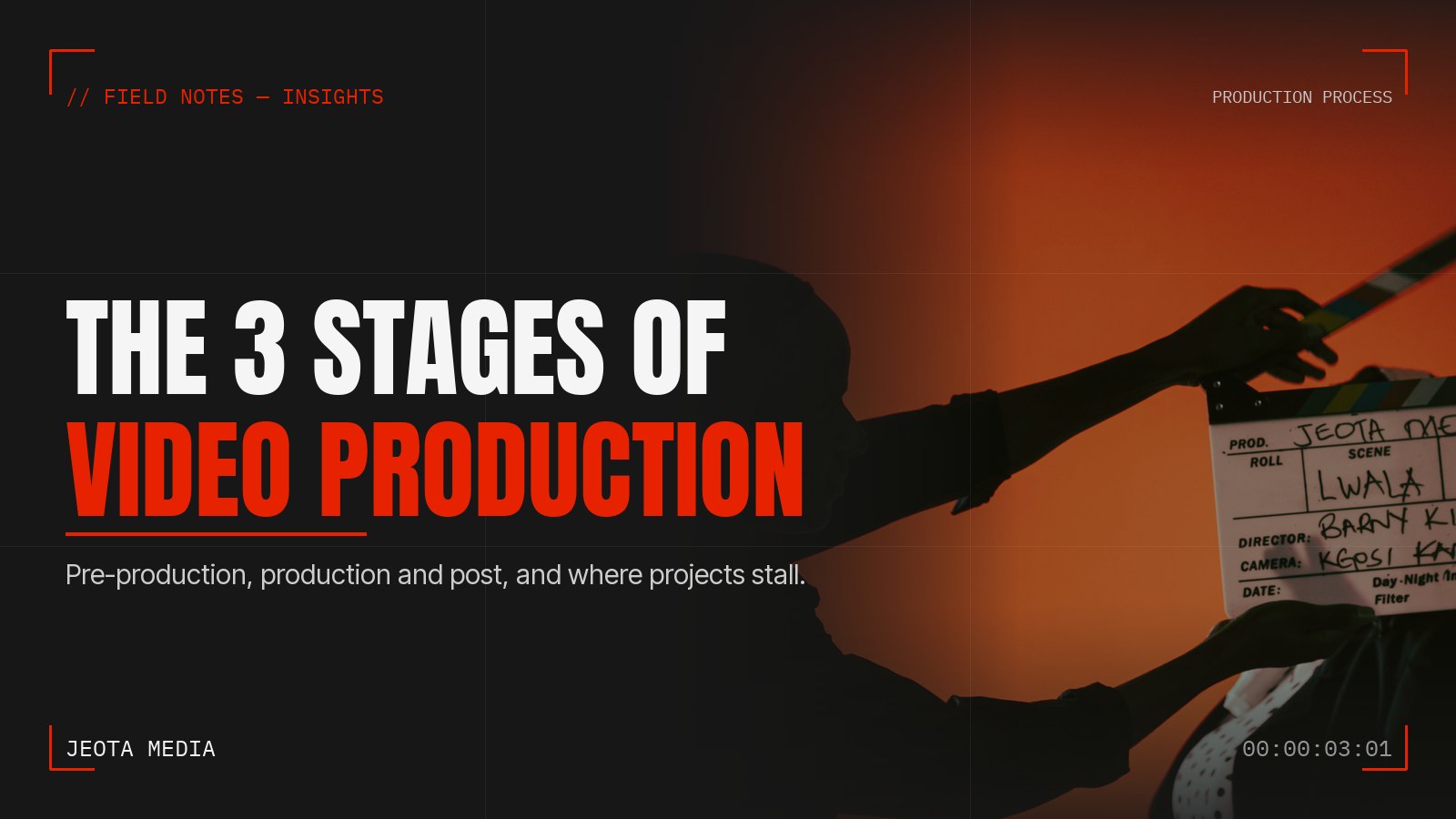
Video production is generally divided into three main stages: pre-production, production and post-production.
Each stage has a different purpose, and each one affects the quality of the next. A rushed pre-production process can create problems on shoot day. A poorly planned shoot can make editing much harder. And even great footage can lose its impact if the post-production process isn’t handled properly.
Let’s break down how the whole process works.
What Are the 3 Main Stages of Video Production?
The three main stages are:
- Pre-production — planning everything before filming begins
- Production — capturing the video, audio and other visual material
- Post-production — turning the raw footage into the finished video
Think of it like building a house. Pre-production is where you create the plan. Production is where you build it. Post-production is where you finish everything and make sure it is ready for people to see.
Skipping any of these stages isn’t really an option. The amount of planning and work involved can change depending on the project, but all three stages matter.
1. Pre-Production: Where the Video Takes Shape
Pre-production happens before the cameras start rolling. This is arguably one of the most important parts of the entire process because this is where a vague idea starts becoming an actual production plan.
You might begin with something as simple as: "We need a video to introduce our company."
That’s a starting point, not a production plan. Before filming, the team needs to figure out what the video is actually supposed to accomplish.
What happens during pre-production?
Depending on the project, pre-production can include:
- Defining the video’s objective
- Identifying the target audience
- Developing the concept
- Writing the script
- Creating a video production brief
- Developing a storyboard
- Creating a shot list
- Choosing locations
- Casting presenters, actors or interviewees
- Planning lighting and sound
- Organising equipment
- Creating the production schedule
- Coordinating the crew
- Planning logistics
This is also where important creative decisions are made. For example, if you’re producing a corporate video, you might decide that the story should be told through employee interviews rather than through a scripted voiceover.
That decision affects almost everything that follows: who needs to be on camera, what questions need to be prepared, what locations you’ll need, what B-roll you should capture and how the final edit will come together.
Why is pre-production so important?
Because problems are much easier to solve on paper than they are on a production set.
Imagine arriving at a location and discovering that the interviewee wasn’t briefed properly, the room is too noisy, the required shots weren’t planned, or there isn’t enough time in the schedule to capture everything. You can sometimes fix these problems.
But fixing them on the day usually costs more time, money and energy than planning for them beforehand. Good pre-production doesn’t mean predicting every possible problem. It means reducing the number of problems you’re likely to encounter.
Storyboards and shot lists
Two tools that often come up during pre-production are storyboards and shot lists. A storyboard gives the team a visual idea of how scenes or shots are expected to look. A shot list, meanwhile, provides a practical record of the shots that need to be captured. They serve different purposes, but both help the production team arrive on set with a clearer idea of what needs to happen.
Not every video requires a detailed storyboard. A simple interview project may not need one, while a commercial with multiple scenes, actors and camera movements might benefit significantly from detailed visual planning. The right level of planning depends on the project.
2. Production: Where the Cameras Start Rolling
Now we get to the part most people associate with video production: filming. This is the production stage.
The plans created during pre-production are put into action, and the team captures the footage, audio and other material needed for the final video. But production isn’t simply a matter of pressing record. A typical shoot can involve several people working together, depending on the scale and requirements of the project.
You may have:
- A producer coordinating the production
- A director guiding the creative execution
- Camera operators capturing footage
- A sound professional managing audio
- Lighting crew shaping the environment
- Production assistants handling logistics
- Presenters, interviewees or actors
- Other specialists depending on the project
A two-person interview shoot and a large commercial can have very different production setups. The important thing is that the crew and equipment match what the project actually requires.
What happens on a production day?
A shoot might involve:
- Setting up equipment
- Preparing the location
- Checking lighting
- Testing audio
- Framing and composing shots
- Briefing people appearing on camera
- Capturing the planned shots
- Reviewing footage where necessary
- Capturing additional B-roll
- Packing down equipment
And then doing it again for the next setup.
This is where pre-production really earns its keep. When everyone knows what needs to be captured, the production day becomes much easier to manage. Of course, things can still change. Maybe the weather changes. Perhaps a location becomes unavailable. An interview takes longer than expected. A better shot presents itself.
Good production teams need to be able to adapt without losing sight of the project’s original objective.
3. Post-Production: Turning Footage Into a Story
Once filming is finished, the project isn’t finished. In many ways, the storytelling work is only beginning. Post-production is where all the material captured during production is organised, edited and shaped into the final video.
This can include:
- Reviewing and organising footage
- Selecting the strongest takes
- Editing the video
- Cleaning and mixing audio
- Adding music
- Colour correction and colour grading
- Motion graphics
- Titles and captions
- Visual effects where required
- Voiceover
- Sound design
- Creating different versions for different platforms
- Client review and revisions
- Final quality control
- Exporting and delivering the finished files
Editing is more than putting clips together
One of the biggest misconceptions about video editing is that it is simply a matter of arranging clips in the right order. It isn’t.
An editor is making decisions about pacing, structure, emotion, information and attention. A ten-minute interview might contain only two minutes of material that ultimately makes it into the final video. That doesn’t mean the other eight minutes were wasted. Those additional moments give the editor options.
Maybe one answer works better when paired with B-roll. Perhaps a pause needs to be removed to improve pacing. Maybe a different section of the interview provides a much stronger opening. The edit is where all those decisions come together.
Why the Three Stages Are Connected
It’s tempting to think of pre-production, production and post-production as three completely separate jobs. They’re not. They’re connected. A decision made during pre-production can affect production. A decision made during production can affect post-production. And something discovered during editing can reveal that additional footage or information is needed.
For example:
Pre-production: The team decides the video should feel energetic and fast-paced.
Production: The camera team captures a variety of wide, medium and close-up shots, along with plenty of movement and B-roll.
Post-production: The editor has enough visual variety to create a fast-paced sequence without relying on the same shot repeatedly.
The final result works because the three stages were working toward the same creative objective.
What Happens When One Stage Is Rushed?
This is where video production can become expensive. Suppose a project moves straight from an idea to filming without enough planning. The team might discover on the day that:
- The script doesn’t quite work
- Important shots weren’t considered
- The location doesn’t suit the concept
- There isn’t enough time in the schedule
- The interview questions aren’t producing useful answers
- Additional equipment is required
- Nobody is sure what the final video is supposed to achieve
Now the production team has to solve those problems while the clock is running. The same applies to post-production. If the footage isn’t organized properly, the audio is inconsistent, or key shots weren’t captured, the editor has fewer options.
This is why professional video production isn’t simply about having good cameras. The process matters.
How Long Does Video Production Take?
There’s no universal timeline. A short social media video might be planned, filmed and edited relatively quickly. A large corporate production, documentary or commercial campaign can take considerably longer.
The timeline depends on factors such as:
- The complexity of the concept
- Number of filming locations
- Number of people involved
- Script requirements
- Amount of footage
- Production crew size
- Motion graphics and visual effects
- Number of final deliverables
- Client review cycles
- Revision requirements
This is another reason why a good production brief matters. The clearer the project is at the beginning, the easier it becomes to estimate the resources and time required.
Which Stage of Video Production Is Most Important?
It’s a bit of a trick question. All three matter.
- Strong pre-production can make production smoother.
- Strong production gives post-production better material to work with.
- Strong post-production turns that material into a coherent final story.
Think of it as a chain. Planning → Capturing → Shaping
If one link is weak, the final product can suffer. That doesn’t mean every project needs an enormous pre-production process or a huge production crew. It means the process should be appropriate to the project’s goals.
A simple talking-head video shouldn’t be treated like a feature film. At the same time, a complex commercial shouldn’t be approached like someone casually filming a few clips for social media. The production approach should match the job.
What Should You Do Before Starting a Video Project?
Before contacting a production company, you don’t necessarily need to have everything figured out. In fact, that’s part of what a production team can help with. But it helps to have answers to a few basic questions:
1. What is the purpose of the video?
Are you trying to educate, promote, explain, document, recruit or tell a story?
2. Who is going to watch it?
Your audience should influence the tone, structure and distribution strategy.
3. Where will it be used?
A video intended for a website may need to be approached differently from one designed primarily for social media.
4. What do you want people to do after watching?
Watch another video? Visit your website? Make an enquiry? Understand a concept? Remember your brand?
5. What does success look like?
Having a clear objective makes it easier to make creative decisions later.
You don’t need a 30-page production document to answer these questions. But knowing the basics gives the production team something to work with.
The Bottom Line
Video production is a process that starts long before filming and continues after the cameras have been packed away.
- Pre-production gives the project direction.
- Production captures the material needed to tell the story.
- Post-production turns that material into the finished video.
And when all three stages work together, the result is much more than a collection of nice-looking shots. It’s a video with a purpose, a structure and a reason for existing.
At Jeota Media, we approach video production as a complete process rather than treating filming and editing as isolated tasks. Whether you’re developing a corporate video, promotional campaign, social media content or another type of production, the right process starts with understanding what you’re trying to achieve.
Planning a video project? Talk to Jeota Media about how we can take it from the first idea to the final cut.
Planning a video? Jeota Media produces brand films, documentaries, commercials and social content for organisations across Kenya and East Africa. Tell us about your project or explore our services.
Frequently Asked Questions
What are the three main stages of video production?
The three main stages are pre-production, production and post-production. Pre-production covers planning, production covers filming, and post-production covers editing and final delivery.
What happens during pre-production?
Pre-production can include concept development, scripting, storyboarding, shot lists, location scouting, casting, scheduling, equipment planning and other logistical preparations.
What happens during production?
Production is the filming stage. The crew captures video, audio and other material needed for the final project.
What happens during post-production?
Post-production includes editing, audio work, colour correction and grading, graphics, captions, sound design, revisions, quality control and final delivery.
How long does video production take?
It depends on the project’s complexity, number of locations, crew requirements, amount of footage, editing requirements and number of deliverables. A simple video may take considerably less time than a multi-location commercial or corporate production.
Do all videos need a storyboard?
No. Storyboards are particularly useful for productions where specific shots, scenes or visual sequences need to be planned in advance. Simpler productions may only require a shot list or production brief.
